• Best Practices and Tools for Software Development – CodeRefinery

    This CodeRefinery online workshop will take place for 6 half-days in two instalments, September 19-21 and September 26-28, 2023. In this course, you will become familiar with tools and best practices for version control and reproducibility in modern research software development. The main focus is on using Git for efficiently writing and maintaining research software. […]
  • AI on HPC

    Online

    Are you an AI developer that is interested in scaling up and use supercomputers? EuroHPC JU is organising a three-hours virtual event, an Information Day called “AI on HPC”, about: You can learn more about this event and register using the link below.https://eurohpc-ju.europa.eu/news-events/events/eurohpc-ju-information-day-ai-supercomputers-virtual-2023-09-26_en

  • Best practices in HPC training

    Online

    This instructor training workshop is focused on helping competent practitioners and experts in various fields teach their knowledge to others. It also serves a kickstart to teaching ENCCS lessons. The two-half-day online workshop will present best practices in teaching technical topics both online and in-person and is based on past experiences from both ENCCS and […]

  • Julia for High Performance Data Analysis

    Online

    Julia is a modern high-level programming language that is fast (on par with traditional HPC languages like Fortran and C) and relatively easy to write like Python or Matlab. It thus solves the “two-language problem”, i.e. when prototype code in a high-level language needs to be combined with or rewritten in a lower-level language to […]

  • Julia for High-Performance Scientific Computing

    Online

    Julia is a modern high-level programming language that is fast (on par with traditional HPC languages like Fortran and C) and relatively easy to write like Python or Matlab. It thus solves the “two-language problem”, i.e. when prototype code in a high-level language needs to be combined with or rewritten in a lower-level language to […]

  • Quantum Autumn School

    Chalmers University of Technology Gothenburg

    Registrations closed Recent developments in quantum computing are bringing the world closer to a new technological revolution – the advent of usable quantum computers able to provide enormous acceleration to important computational tasks. In coming years, quantum computing is expected to have a significant impact on many areas of research that can utilise computational modelling.  […]

  • Python for Scientific Computing

    What does this Python course include? This is a medium-advanced Python course focusing on tools such as NumPy, SciPy, Matplotlib, and Pandas. It is suitable for people who know basic Python and want to know some internals and important libraries for science - basically, how a typical scientist actually uses Python. Read the learner personas to see […]

  • High-Performance Programming

    Online

    Registrations are now closed. Welcome to our online workshop on High-Performance Programming, focusing on single-core performance optimisation. Over the course of three half-day sessions, we will delve into the intricacies of algorithms, algorithms and complexity, cache efficiency, SIMD vectorisation, and compiler optimisations. We will keep a practical focus on useful techniques and mindsets. Who is […]

  • ENCCS Industry Days 2023

    Stockholm

    Welcome to ENCCS Industry Days 2023! This event provides a comprehensive introduction to supercomputing. Industry Days is for both managers and software developers who are interested in finding out how supercomputers are used in different industrial sectors.

    Free
  • EuroHPC User Day

    Charlemagne Building, Brussels Belgium

    Have you had access to a EuroHPC JU supercomputer? If yes, then register at the EuroHPC User day in Brussels, Belgium!

  • [Webinar] Practical intro to GPU programming in Python and Julia

    ENCCS and SciLifeLab are organising a webinar giving an intro on GPU programming in Python and Julia. This event is part of the Tools for AI/ML research in life sciences. Practical information Title: Practical intro to GPU programming in Python & JuliaSpeaker: Yonglei Wang, PhD, Training Coordinator and Research Software Engineer and HPC application expert at ENCCSAbstract: Availability of […]

  • Space Plasma Simulations with Vlasiator on LUMI Supercomputer (Hybrid event)

    Innoversum at Drottning Kristinas väg 61 Drottning Kristinas väg 61, Stockholm, Sweden

    Overview ENCCS comes together with Plasma-PEPSC CoE for the organisations of this hybrid workshop to bring together code developers, researchers, and research software engineers working on plasma science, and create an amazing opportunity for sharing innovative ideas and best practice for potential users to use the Vlasiator package and using its capabilities and assorted tools […]

    Free
  • Efficient materials modelling on HPC with QUANTUM ESPRESSO, SIESTA and Yambo (Online)

    Online

    This workshop will give a broad overview of important fundamental concepts for molecular and materials modelling on HPC, with a focus on three of the most modern codes for electronic structure calculations (QUANTUM ESPRESSO, SIESTA and Yambo). Participants will put their new knowledge to the test on the Leonardo EuroHPC JU supercomputer (https://leonardo-supercomputer.cineca.eu/hpc-system/) with theory sections and practical demonstrations and hands-on exercises.

    Free
  • N-ways to GPU Programming Bootcamp

    The N-Ways to GPU Programming Bootcamp covers the basics of how to use GPUs and provides an overview of different methods for porting scientific application to GPUs using NVIDIA® CUDA®, OpenACC, standard languages, OpenMP offloading, and/or CuPy and Numba.

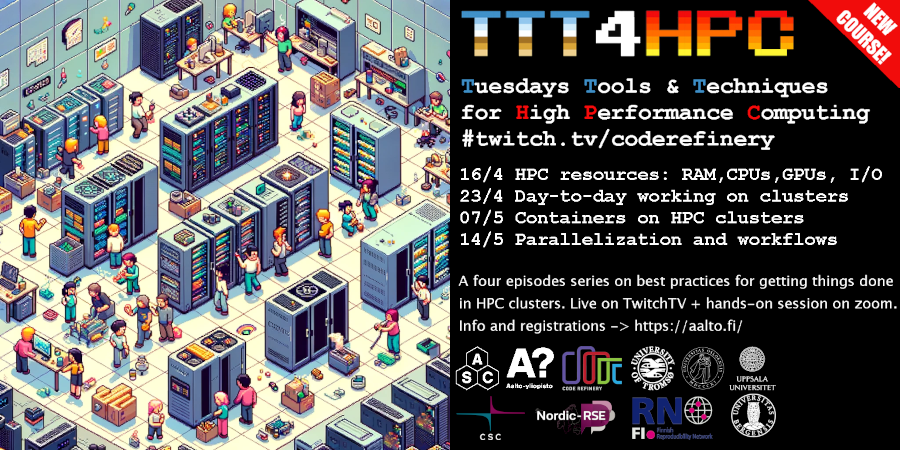
  • Tuesday Tools & Techniques for Supercomputing

    🗓️ 16, 23 April & 7, 14 May 2024 Do you use supercomputers in your research work? Are you curious about making your computing faster and more efficient? Join us for TTT4HPC: four self-contained episodes on tools and techniques for supercomputing. It is a great chance to enhance your computational skills. What you will learn […]

  • 4th Baltic HPC and Cloud Conference

    Welcome to the 4th Baltic HPC and Cloud Conference! About The conference will feature a lot of topics, including talks on innovative uses of HPC and Cloud computing and presentations about HPC/Cloud computing services ranging from EuroHPC supercomputers to Quantum Computing. Historically, the conference was organised by Riga Technical University, HPCEuropa3 project, University of Tartu, […]

    Free
  • VASP/EMTO Best Practices Workshop

    Online

    ENCCS comes together with NAISS to organise the VASP/EMTO Best Practices Workshop. During the workshop we will showcase how to run the VASP (Vienna Ab-initio Simulation Package) and the EMTO (Exact Muffin-Tin Orbitals) packages efficiently on supercomputers. Who is this workshop for? The workshop is mostly suitable for material scientists beginners and intermediate users at […]

    Free
  • Leveraging supercomputers for data-driven life science research: examples from Berzelius

    Life science and supercomputing Powerful GPU supercomputers allow us to carry out large-scale life science experiments in a fraction of the time that it would otherwise take. They also allow us to pursue research projects that would otherwise not be possible. Life science researchers at Swedish universities can apply and make use of the Berzelius […]

  • Multi-GPU Programming Bootcamp

    Overview Welcome to the Multi-GPU programming bootcamp! Scaling applications to multiple GPUs across multiple nodes requires one to be adept at programming models and optimisation techniques, and proficient at performing root-cause analysis using in-depth profiling to identify and minimise bottlenecks. Topics on GPU programming covers single node multi-GPU (P2P) and multi-Node multi-GPU (GPU Direct) programming, […]

  • AI for Science Bootcamp

    Online

    The AI for Science Bootcamp provides a step-by-step overview of the fundamentals of deep neural networks related to scientific computing and physical systems defined by differential equations.